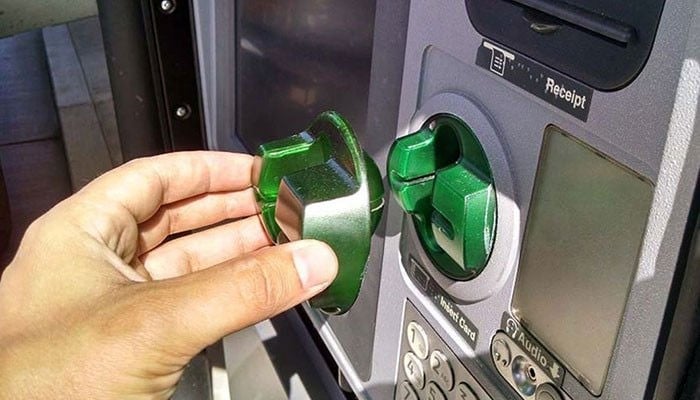
Chinese nationals convicted in ATM skimming. Photo: Geo News
KARACHI:
A district court sentenced two Chinese nationals to one-year
imprisonment and imposed a fine of Rs50,000 each over their involvement
in automated teller machine (ATM) skimming here on Monday.
According to the Federal Investigation Agency (FIA), the suspects were involved in manipulating ATM machines to take out money.
FIA
informed the court that the two suspects were caught red-handed while
installing a skimming device at an ATM on Karachi's Abdullah Haroon
Road. It was reported that the arrested foreigners were seen
suspiciously doing the rounds of an ATM booth on Karachi's Abdullah
Haroon Road for the past three days.
Citizens took hold of the
suspects and handed them over to police. They were moved to Artillery
Maidan police station for investigation.
Meanwhile, CCTV footage of an ATM booth also showed the suspects installing a skimming device.
ATM skimming is can be regarded
as identity theft for debit cards. Fraudsters employ different
techniques to record your PIN code for accessing the hard-earned money
in your account.
In some instances, the schemers stick a fake
card-reader on the ATM, while in others they place a fake keypad on the
machine to get your PIN code.
Another technique employed in this
crime is the use of a hidden camera, which records your PIN code and
conveys it to fraudsters.
A few ATM skimmers also change the entire display of the ATM.
How to safeguard yourself against such schemes?
To
avoid the loss of your hard-earned cash, it is necessary for you to
check there is no hidden on unusual device attached to the ATM you are
using.
Your PIN code is vital for the schemers and they are unable
to withdraw cash with it. One must punch his PIN code in a way that
avoids detection by a hidden camera placed somewhere on and around the
machine.
Do not withdraw money if you sense anything unusual at an ATM and immediately inform concerned bank officials.
سندھ بلڈنگ کنٹرول اتھارٹی نے شادی ہالز، میرج گارڈن اور بینکوئٹ ہالز کےلیے پالیسی جاری کردی ہے، جس کے مطابق شادی ہال یا بینکوئٹ کے لیے کم از کم رقبہ دو ہزار گز ہونا لازمی ہوگا ۔
شادی ہال کے سامنے ڈیڑھ سو فٹ یا اس سے زیادہ چوڑی سڑک کاہونا بھی ضروری ہوگا۔
سندھ بلڈنگ کنٹرول اتھارٹی (ایس بی سی اے) نے واضح کیا ہے کہ رہائشی پلاٹس کو کمرشل بنیادوں پراستعمال کرنے کے لیے مالکان کو رہائشی پلاٹس کو کمرشل پلاٹس میں تبدیلی کے لیے کنورژن فیس ادا کرنا ہوگی ۔
رہائشی پلاٹس کے بطور شادی ہال یا بینکوئٹ استعمال کے لیے ان کے سامنے ڈیڑھ سو فٹ چوڑی سڑک ہونا ضروری ہوگا ۔
ایسے شادی ہالز جو فلاحی پلاٹس پر قائم ہیں ،وہ پالیسی کا نوٹیفکیشن جاری ہونے کے 6ماہ کے اندر بند کرنے دئیے جائیں ورنہ انہیں گرادیا جائے گا ۔
رہائشی پلاٹس پر ریگولرائزڈ کیے گئے میرج ہالز کو اصل دستاویزات کی متعلقہ ڈپارٹمنٹس سے ویری فکیشن کے بعد ریگولرائزڈ میرج ہالز کا درجہ دیا جائےگا ۔
VATSIM (short for the Virtual Air Traffic Simulation Network) is a completely free online platform which allows virtual pilots, wherever they are in the world, to connect their flight simulators into one shared virtual world. VATSIM also simulates air traffic control in this virtual world, creating the ultimate as-real-as-it-gets experience for you, the virtual aviation enthusiast.
With over 76,000 active members in 2014, connecting your flight simulator to VATSIM allows you to join hundreds of other pilots in our virtual skies, flying all kinds of aircraft all over the world. As a VATSIM member, you can join our many communities across the world to enhance your flying skills and flight simulator experience in a shared virtual airspace. You can also become a virtual air traffic controller, adding that extra bit of realism for you and your fellow enthusiasts. The real beauty of VATSIM is that it caters people who are completely new to the hobby as well as to the seasoned flight simmer.
The beginning
VATSIM was founded in July 2001 by a group of individuals who came together with the idea of creating an online community which truly met the needs of flight simulator enthusiasts across the world. As well as providing a common network for flight simulation enthusiasts to connect to, VATSIM aimed to create a global community for learning, sharing experiences and pursuing new opportunities in the virtual world. That original group of individuals are now referred to as theVATSIM Founders, and help to steer the direction of the network.
Our Structure
VATSIM is led by theBoard of Governors, a group of individuals who each take on a specific specialism on the network to lead. TheBoard of Governorsare supported by anExecutive Committee, who represent theRegionsof VATSIM, who are in turn supported by local staff structures. Everyone is a volunteer.
The VATSIM world is divided intoRegions, then Divisions and finally local facilities, which take on a number of different names depending on where you are in the world. These structures help to build and maintain communities across the globe, providing resources, training and a place to share the experience of VATSIM wherever you are. VATSIM is also the main network for many established Virtual Airlines and other virtual flying groups, whose pilots populate our skies every day with hundreds of flights.
The most important part of the network is you: our members. You are free to enjoy VATSIM in the way you want to enjoy it, by flying, controlling, or both. VATSIM is a network for all to enjoy, and it can be whatever you make it. Welcome.
I'm
a translator and a PhD candidate at the Leiden University. My thoughts
are scattered across Indonesia, Pakistan, Poland, and Twitter
(@cukiereczki).
How a Polish World War II fighter pilot became a national hero in Pakistan
Władysław Turowicz, a key force
behind Pakistan's nuclear programme, rebuffed attempts by the Polish
secret services to recruit him as a spy.
Image credit:
via Dawn.com
Turowicz’s
health was deteriorating. He knew he was a financial burden to his
family. It would come as no surprise if he committed suicide, a Polish
intelligence officer wrote in 1971.
Wadysaw Józef Marian Turowicz
was one of the refugee pilots from Poland who joined the Royal Air Force
and fought for Britain during World War Two. No longer needed by the
Allies after the war and unwelcome in their newly communist homeland,
some of the pilots settled in Pakistan and helped establish one of the
most admired air forces in the world at the time.
An aeronautical
and astrophysics engineer in addition to being an avid pilot, he would
go on to rise to the rank of Air Commodore and also headed up its space
and missile programmes. Pakistan would bestow numerous national and
military honours on him, and also grant him and his family Pakistani
citizenship.
He helped establish the Pakistan Air Force and was
known as the godfather of Pakistan’s space and missile programme. But
Air Commodore Władysław Turowicz (pronounced Vuadisuav Turovich) was a
Pole who became a Pakistani hero.
His name does not exist on the
pages of Polish history, but he figures in the records of Służba
Bezpieczestwa, or SB, the security service of the Ministry of Internal
Affairs of the People’s Republic of Poland, which allocated a big budget
and a group of its best men to recruit Air Commodore Turowicz into its
structures.
“Did he spy against Pakistan?” I asked the employee of
Poland’s Institute of National Remembrance in Warsaw who guided me
through the microfilms on Turowicz and his family. The
institute has recently opened to the public thousands of files from the
notorious agency that was the main intelligence organisation in
communist Poland from 1956 until the end of the People’s Republic in
1989.
“It is not clear, there’s been no research on the Polish
pilots in the Pakistan Air Force, so you must go through all these files
to find out. But I hope he didn’t. Those pilots were people of better
sort, of much higher standards,” he said, leaving me with the SB
reports, intercepted letters to family members, photographs, bills,
medical checks, conversation transcripts, and handwritten notes of
several agents involved in recruiting Turowicz. Turowicz with other officers (Chaklala, 1954) -Photos by Tahir Jamal/White Star. Courtesy Pakistan Air Force Museum.The
SB’s preliminary note says Turowicz, with his high rank in the
Pakistani military, huge respect and knowledge, would be a valuable
asset for the organisation. It seems they became interested in
recruiting him when he joined the national space agency after the
India-Pakistan war of 1965, and further reinforced their efforts when
Pakistan was about to launch its nuclear programme.
According to
the biographical file, Turowicz was born in 1909, in Wadziejewsko
village, Siberia, to an aristocratic family. The very Polish name of the
village might suggest it was a colony for Poles imprisoned or exiled by
the Tsar; it is also unlikely that Polish aristocrats would live far in
the Amur valley, on the border of Russia and China, for reasons other
than political.
In 1920, with his parents and siblings, Turowicz
began the journey to Poland, which finally was a sovereign republic
again after 150 years when Russia, Prussia and Austria annexed its
lands.
They reached Poland in 1922 and settled down in Warsaw.
After matriculation, Turowicz was enrolled at the Faculty of Aviation of
the Warsaw University of Technology. A brilliant aeronautical engineer,
he graduated with honours.
He liked air racing. In 1936, at the
Warsaw Aero Club, he met his future wife Zofia who, at the age of 20,
was already a famous glider pilot. At the outbreak of World War Two,
Turowicz – then a Polish Air Force lieutenant – was stationed in
south-western Poland. He received the order to retreat to Romania and
was soon locked up in an internment camp. Zofia found him there in 1940,
and somehow managed to receive permission for them to marry.
In
autumn 1940, they began the journey to the West. Through Hungary,
Yugoslavia, Switzerland and France, they reached England. Turowicz
joined the Royal Air Force as a flying instructor and a test pilot. Turowicz
being decorated by President Ayub Khan in 1966 for meritorious service
to the Pakistan Air Force -Photos by Tahir Jamal/White Star. Courtesy
Pakistan Air Force Museum.The first SB officer
in charge of recruiting Turowicz reported he could not get accustomed to
life in England and left when an opportunity arose in 1948. That
opportunity was in the newly formed state of Pakistan and he moved with
30-odd other Polish pilots to the RAF base in Karachi.
The
statement is unconvincing. Unfortunately, documents on the group of
Polish pilots who helped establish the Pakistan Air Force remain
classified in Great Britain, which had seen over 8,000 Polish air
personnel arrive on its shores in 1940. Many of them, who could no
longer fight in their country, which had been torn to pieces by the
Nazis and Soviets, believed they could strive against the German
Luftwaffe from the sceptred isle.
Polish Squadron 303 was considered the best unit in the Battle of Britain.
But
the RAF no longer needed them after the war. Neither did Poland. Many
pilots who returned after the war were imprisoned by the new communist
regime. The government of Pakistan chose 30 Polish officers from the
RAF, offering them three-year contracts and a home when they could not
return to their land of original belonging.
A beautiful documentary film directed by Anna Pietraszek, Polish Eaglets Over Pakistan (2008), has thus far been the only attempt to bring them back – or at least their names – to Poland. A
monument in honour of Turowicz at the Pakistan Air Force Museum -Photos
by Tahir Jamal/White Star. Courtesy Pakistan Air Force Museum.Group
Captain (retired) S Ahtesham A Naqvi of PAF spoke to Pietraszek about
how, even after 60 years, he remembered the Polish pilots as his
teachers and instructors at the Pakistan Air Force Academy in Risalpur,
and as friends.
“Poles came to help us when we were abandoned by everyone else,” he says in the documentary.
The Poles might have felt the same. Plaque at PAF Museum Karachi.Air
Vice Marshal M Akhtar, Air Commodore Kamal Ahmad and Squadron Leader
Ahmad Rafi remember them as kind, noble and soft-spoken. They were not
“foreigners” they say; Turowicz was “like an elder brother”.
Akhtar
says that the first thing that impressed him and which he found
endearing was that Turowicz, as a senior officer, had the privilege to
be served food in his own room but would always come to eat at the
canteen with the younger pilots.
In the SB files, the agent
described him as “a Pakistan enthusiast". He interpreted Turowicz’s
enthusiasm as “a debt of gratitude". Turowicz receiving Prime Minister Khawaja Nazimuddin -Photos by Tahir Jamal/White Star. Courtesy Pakistan Air Force Museum.Turowicz
was interested in everything related to Poland. All of the SB agents
involved in the operation to enlist him – diplomats, representatives of a
foreign trade agency or engineers – observed that Turowicz was a
“pre-war kind of patriot". They were convinced this deep, idealistic
patriotism only needed a proper material incentive to have him
recruited, especially as his health and the family’s financial situation
were not good; Zofia had to become a physics and mathematics teacher to
support them.
"Pre-war" in the Polish language is charged with
meaning other than chronological. Years ago, when it could still be used
for people, my grandmother would recommend a doctor as “a good pre-war
physician". My mother, who had not witnessed the war, often mentions
"pre-war" manners or gallantry if a man has to be described as
courteous. We all know the pre-war intelligentsia was of better quality,
higher moral standards. In this term, there is a lot of what Pakistanis
call lehaaz – good upbringing, graciousness. Air
Commodore Wladyslaw Turowicz (Second from right), Mrs Zofia Turowicz
(Third from left) with other officers and cadets (1954, Chaklala).Between
1918 and 1939, Poland saw remarkable economic and scientific
development, the flourishing of mathematics, philosophy and psychology.
The famous Lwów-Warsaw school of thought was then at the height of its
international recognition. World War Two, followed by nearly half a
century behind the iron curtain, cut this legacy off in every possible
sense.
It was surprising, at the very least, to see the "pre-war"
attribute used by SB functionaries; to many Poles now, their agency
remains the most despicable manifestation of Poland’s post-war reality. Turowicz is buried at the Karachi Christian Cemetery -Photos by Tahir Jamal/White Star. Courtesy Pakistan Air Force Museum.While
reading the letters of Turowicz family members or persons who posed as
their friends, I could not contain the feeling of guilt. Going through
personal correspondence and reports of those who intercepted it feels
like two-fold eavesdropping. At some point, the agents seemed to be
close with Turowicz. Maybe a real friendship was established – if
anything meaningful can flourish from an unequal relationship based on a
betrayal of intimacy.
Through the archive files, I entered
Turowicz’s private life without invitation and with helplessness. In
films, when our heroes are in danger, sometimes, we want to warn them
and change the course of what has already happened – it was the same
kind of futile desire to intervene. Statue of Turowicz at PAF Museum Karachi.In
1966, the SB approached Turowicz’s eldest daughter, who was visiting
her aunt and grandmother in Warsaw. A handsome officer was put in charge
of courting her to gain an entry point to her father. He could have
been successful, as even the aunt and grandmother saw in him a potential
husband for the young lady. But the story ended soon, as another agent
stationed in Pakistan had already begun to establish a cordial
relationship with Turowicz himself.
It seems the first attempt at
recruitment was unsuccessful. During a reception hosted by a Polish
diplomat, one of the guests who allegedly represented the Polish Air
Force insisted on a one-to-one conversation Turowicz. After a while,
Turowicz left the party.
In 1970, Turowicz visited Poland for the
first time after the war, to receive treatment at a well-known
orthopaedic clinic near Warsaw. A doctoral student in engineering was
placed at the same clinic to seek Turowicz’s help in translating English
technical terms. On the last day, the student asked whether Turowicz
loved Poland enough to do something for its benefit. AOC SAC receiving Consul General, Republic of Poland at the PAF Museum-14 August 2006.Turowicz
certainly loved Poland, but that Poland was already owned by the past,
or maybe it never existed. His Poland was a collection of nostalgias –
inherited from parents in Siberia and later his own, and informed by
pre-war nobility and honour.
A few days after the incident with
the agent in student garb, the Polish diplomat who had befriended
Turowicz’s family in Karachi invited him and his sister for a dinner in
Warsaw. Discussion focused on a rumour that the Polish Communist Party’s
secretary’s translator was a spy and had escaped to Germany. After a
long silence, Turowicz confessed he had met many spies, especially
during the India-Pakistan war. He said they were slimy, worthless
people, men without qualities, whom he would never let close.
He then raised his voice: “I will never become one of them.”
The
file ends with signatures, stamps of senior officers and a note that
the operation was aborted since all further attempts to recruit Turowicz
would be to no avail.
Recalling an unlikely Pakistani soldier
Of
the many post-World War Two episodes, one that merits attention is that
of a group of Polish officers and men who sought refuge in Britain
after their homeland was invaded by Germany. Most volunteered for the
armed forces; a considerable number joined the Royal Air Force. Air Commodore Władysław Turowicz.When
Pakistan offered them three-year contracts with high salaries, 30
Polish officers choose to join the Royal Pakistan Air Force as it was
known then. (‘Royal’ was dropped in 1956 when Pakistan became a
Republic). They were led by Squadron Leader Wadysaw Józef Marian
Turowicz, a pilot and engineer. He was commissioned in the Polish Air
Force as an aeronautical engineer and fighter pilot, but later
immigrated to the United Kingdom to join the RAF.
During World War
Two, he flew the British-built Handley Page Halifax Bomber and also
served in the RAF Aeronautics Division as a technical inspector,
overseeing aircraft electrical and system information for organising,
testing and evaluating aircraft.
When Turowicz joined the Royal
Pakistan Air Force in 1948, he brought his tremendous skills and
knowledge with him. He set up technical institutes in Karachi, and
taught at and revitalised the Pakistan Air Force Academy, where he also
worked as chief scientist. In 1952, Turowicz was promoted to the rank of
Wing Commander, in 1959, to the rank of Group Captain, and in 1960 he
became an Air Commodore and an Assistant Chief of Air Staff in charge of
PAF’s Maintenance Branch. Air HQ staff circa 1961-Turowicz seated extreme right.In
1966, the government of Pakistan transferred Turowicz to the Space and
Upper Atmosphere Research Commission (Suparco), Pakistan’s national
space agency, as its chief scientist. After the Soviet Union’s launch of
Sputnik, he and Nobel laureate Dr Abdus Salam successfully convinced
the then president, Ayub Khan, of the importance of a space programme
for a developing country like Pakistan. The duo also persuaded the US
government to invest and train Pakistan’s scientists in the field of
rocket technology.
Turowicz was appointed head of Suparco in 1967
where he initiated the space programme, upgraded the Sonmiani Satellite
Launch Centre, installed the Flight-Test Control Command, the Launch Pad
Control System and System Engineering Division. Turowicz embarked upon a
project for the fabrication and launch of a Pakistani satellite that
enabled Pakistan to master the field of rocket technology. Few people
are aware that the renowned engineer designed ballistic missiles of
short and medium range and also participated in the development of
Pakistan’s nuclear programme. Mrs Zofia Turowicz (third from left) with other instructors and cadets (Chaklala,1954).Turowicz
was killed in a car crash on January 8, 1980. He was buried with full
military honours. For his meritorious service, Turowicz was honoured
with many awards including the Sitara-i-Pakistan, the Tamgha-i-Pakistan,
the Sitara-i-Khidmat, the Sitara-i-Quaid-i-Azam, the Sitara-i-Imtiaz,
the Abdus Salam Award in Aeronautical Engineering and the ICTP Award in
Space Physics. The Pakistan Air Force placed a memorial in honour of Air
Commodore Turowicz at the PAF Museum while Suparco established the
Wadysaw Turowicz Space Complex in Lahore.
A side note: Zofia,
Turowicz’s wife, also contributed to the Pakistan Air Force in her own
way. She taught gliding to Shaheen Air Cadets in Karachi and Rawalpindi,
and applied mathematics and particle physics at Karachi University.
She, too, was honoured by Pakistan’s government for her achievements and
was awarded the Pride of Performance and Sitara-i-Imtiaz. Life sketch at PAF Museum Karachi.This article first appeared on Dawn.



 Tariq Fatemi rejects inquiry committee allegations against him in farewell letter


